Regulatory Update: Keeping CRA, DORA and the Next Deadlines for 2027 in Sight
Regulatory Update: Keeping CRA, DORA and the Next Deadlines for 2027 in Sight
When IT executives look back at the year 2026, it will go down in history as the year the NIS-2 directive dictated budgets and roadmaps. Many organizations made massive efforts to harden their IT security processes, establish reporting channels, and generate evidence for auditors. The collective sigh of relief following the successful completion of these projects is clearly palpable across the industry.
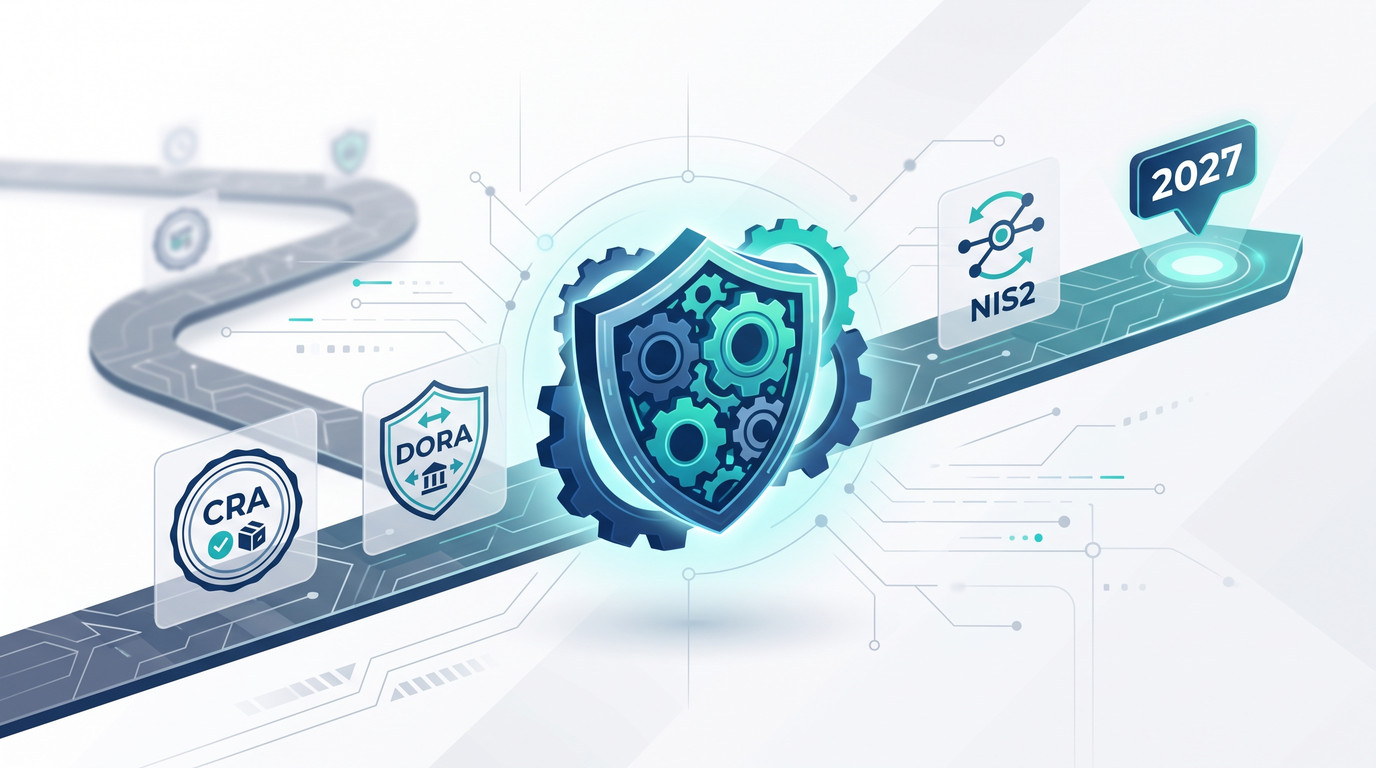
However, anyone who believes that a phase of regulatory relaxation is now setting in is gravely mistaken. In recent years, the European legislator has woven a dense, interlocking web of cyber laws. NIS-2 was merely the foundation. With the Cyber Resilience Act (CRA) and the Digital Operational Resilience Act (DORA), the next, even more specific regulations are already in the starting blocks for 2027.
In this post, we provide a strategic regulatory update. We explain what you need to prepare for now, how DORA and CRA differ from NIS-2, and—most importantly—why you shouldn't buy a new tool for every law, but instead need a central data base.
DORA: The Digital Stress Test for the Financial Sector
Let's start with DORA. While NIS-2 takes a very broad approach across 18 key sectors, DORA is a highly specific framework for the European financial sector (banks, insurance companies, crypto service providers)—and for their IT service providers (ICT Third-Party Providers).
Even if you are not a bank: as soon as you provide IT services for the financial sector, you fall within the scope of DORA with an extremely high probability. The goal of DORA is to ensure that the European financial system remains functional even in the event of severe operational disruptions (such as a massive cloud failure or a coordinated cyberattack).
The Core Requirement of DORA: ICT Risk Management
DORA requires companies to have near-perfect Information and Communication Technology (ICT) risk management. Article 8 of the DORA regulation is particularly explosive for IT managers. It calls for the "identification, classification, and appropriate documentation of all ICT-supported business functions, information assets, and ICT assets."
This means: you don't just need to know that you operate a server. You must seamlessly document which server supports which financial process, how critical that process is, and which external cloud providers (Third-Party Risk) are involved. Without automated dependency mapping in a modern CMDB, this DORA requirement is practically impossible to fulfill in hybrid environments.
CRA: The End of Insecure Supply Chains
The Cyber Resilience Act (CRA) aims in a different direction: at the manufacturers of hardware and software. As we have already analyzed in previous posts (keyword: SBOMs), products with "digital elements" will have to meet strict security requirements in the future to receive a CE mark.
For you as an operator and user, the year 2027 represents the transition to a new era of patch management and End-of-Life (EOL) tracking. Manufacturers will be forced to publish vulnerabilities and provide patches.
Your Duty: You must know in real-time whether a vulnerability (CVE) freshly reported by the manufacturer exists in your network. The times when outdated software could run undetected on a test server for months are over. If you do not install the patches mandated by the CRA in a timely manner and are hacked as a result, you as the operator are fully liable.
A Single Truth for All Laws
NIS-2, DORA, CRA, GDPR, BSI IT-Grundschutz, ISO 27001—the list of acronyms is getting longer and longer. If you try to satisfy each of these regulations with a separate project, a separate compliance manager, and a separate Excel spreadsheet, you will drive your company into administrative ruin (Compliance Fatigue).
The secret of successful organizations is the realization that the requirements of all these laws overlap in a single, central point: the demand for seamless transparency and historical traceability of IT assets.
- DORA needs the assets for impact analysis in the financial sector.
- The CRA needs the assets for SBOM and patch tracking.
- NIS-2 needs the assets for general risk management and incident reporting.
The solution: A Unified Asset Data Platform like Qbilon. By connecting your cloud environments, virtualization servers, networks, and security tools once via APIs, you create the universal "Single Source of Truth." When the DORA auditor comes, you filter the view to your financial processes and show the dependencies (Dependency Mapping). When the ISO auditor comes, you show historical patch compliance (Time Machine). You satisfy a dozen regulators from a single, automated data source.
Conclusion: Build a Foundation That Allows for Scaling
Regulation is the new normal in IT. Those who fear every new law have not yet mastered their foundation.
Stop practicing compliance retrospectively for the last audit. Turn your gaze toward 2027. With a data-driven, automated CMDB, you establish an IT memory that is so agile and complete that you can face the next draft law from Brussels with complete relaxation. Transparency is the only universal remedy for regulatory stress.