Automated Sensor Management: Increasing Efficiency in Monitoring
Automated Sensor Management: Increasing Efficiency in Monitoring
In previous posts, we have discussed in detail how important it is to have a complete inventory of all IT assets (servers, laptops, cloud instances). But there is a specific category of assets in your network whose management is often completely overlooked, even though the company's survival depends on them: the sensors of your security and monitoring tools.
Modern IT infrastructures are paved with sensors. The agent of the Endpoint Detection and Response (EDR) solution (e.g., CrowdStrike, Microsoft Defender) runs on end devices. Physical or virtual appliances that analyze traffic (NDR) are attached to the network. In the cloud, software sensors scan for vulnerabilities (Vulnerability Scanner).
We blindly rely on these sensors to warn us of hackers, report outages, and collect compliance data for the next audit. But one essential question is almost never asked: Who actually monitors the monitors?
In this post, we dedicate ourselves to the often neglected topic of "Sensor Management" and explain why manual control leads to fatal blind spots and how Automated Sensor Management saves the efficiency and reliability of your entire security architecture.
The deceptive green dashboard
Imagine you are a security analyst and look at the dashboard of your expensive EDR system in the morning. The dashboard is green. There are no active malware alerts, no ransomware activities. Everything seems secure.
But the dashboard is not telling you the whole truth. It only tells you that everything is fine on the systems where the sensor is active and functional. What the dashboard does not tell you:
- On 50 laptops in the field, the EDR sensor crashed three weeks ago after a faulty Windows update and has never reported back.
- The development department spun up 200 new cloud servers but forgot to include the installation command for the sensor in the deployment script.
- A sophisticated attacker is already in the network and, as their first act, silently deactivated the security sensor on the compromised server.
In all these cases, your dashboard remains green. The sensors are dead, missing, or have been sabotaged. The security team is lulled into a false sense of security while the attack surface grows massively in secret.
The limits of manual reconciliation
Most IT departments try to solve this problem through sporadic, manual checks. Once a month, an administrator exports the list of active servers from the virtualization environment (vCenter) and the list of active EDR agents from the security console. Then they try to reconcile these lists in Excel using VLOOKUP to find the "deltas" (the servers without a sensor).
This process is extremely inefficient, extremely error-prone, and – most critically – it is far too slow. If a sensor fails today and the reconciliation doesn't take place for three weeks, an attacker has 21 days to move undisturbed on that system. For operators of critical infrastructure or NIS-2-regulated companies, such a time delay is unacceptable and a direct compliance violation.
The solution: Automated Sensor Management via CMDB
To ensure the integrity of your security infrastructure, you must fully automate sensor management. An intelligent, API-driven asset platform like Qbilon is the perfect tool for this.
Instead of viewing sensors as isolated tools, Qbilon makes the health status of sensors an integral attribute of every single asset in the central CMDB.
How does this work in practice?
- Establishing the Ground Truth: Qbilon uses APIs to retrieve the absolute truth about the existence of systems directly from the source (cloud providers, hypervisors, network controllers). The system knows with 100 percent certainty: "Currently, 1,500 servers exist in the company."
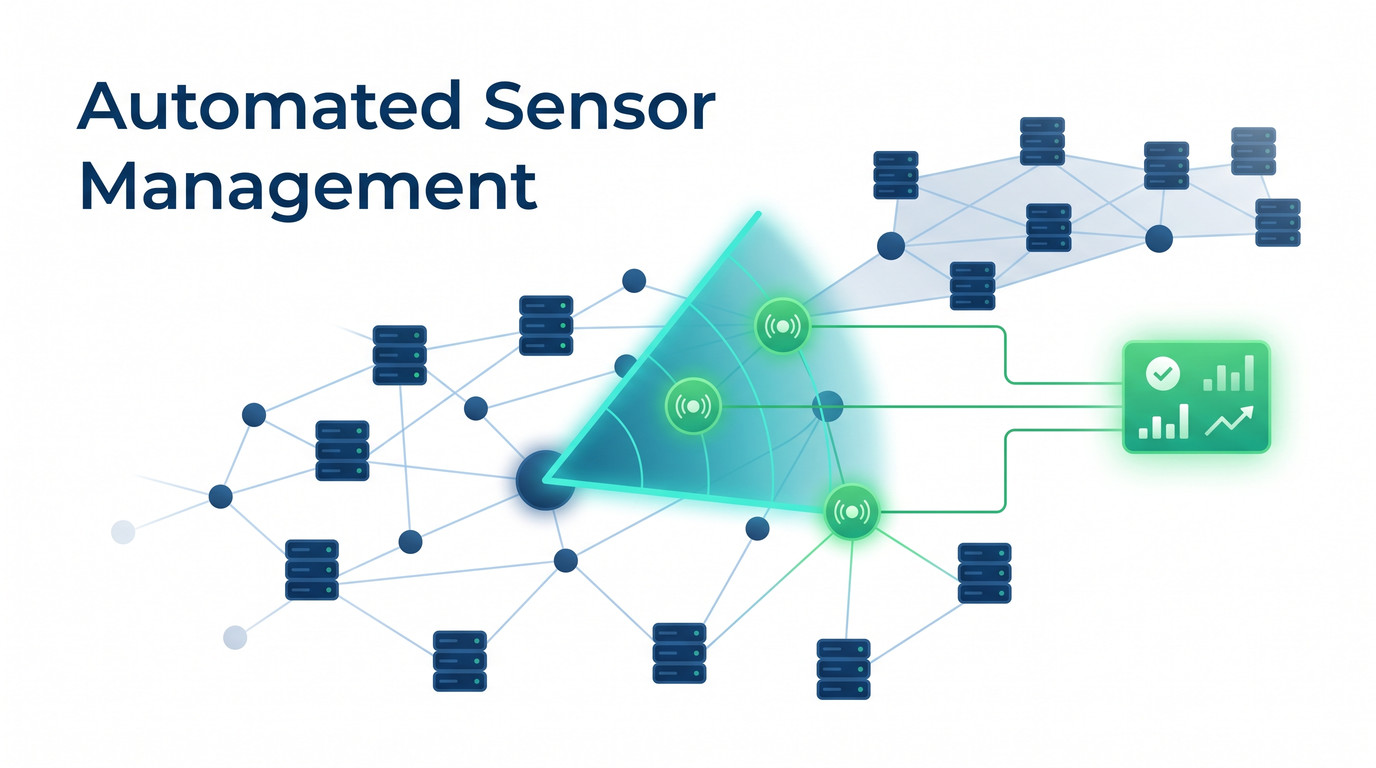
- Continuous Correlation (Coverage Mapping): At the same time, Qbilon integrates via APIs into the management consoles of your security tools. It queries the vulnerability scanner and the EDR system every minute: "Which systems do you currently see as active?" The platform overlays these datasets in real time.
- Automated Alerting (Policy Enforcement): Now the magic of automation takes hold. You define a simple rule in the platform: Every server MUST have an active EDR sensor. If a sensor crashes, is uninstalled, or a new server starts without a sensor, Qbilon immediately detects this discrepancy between the ground truth and the security truth. Instead of waiting, the platform automatically generates an incident ticket for IT support: "Attention: The EDR sensor on server XYZ (Business Owner: Accounting) has been offline for 15 minutes. Please check."
Conclusion: Trust your monitoring again
Your multi-million dollar cybersecurity investments are only as good as the sensors that feed them with data. A dead or missing sensor is a direct invitation code for cybercriminals.
Manually checking agent coverage is a Sisyphean task in dynamic IT landscapes that frustrates your administrators and endangers your company. With Automated Sensor Management, anchored in a modern asset data platform, you close these dangerous "coverage gaps" fully automatically. You ensure that a green dashboard in your SOC actually means that you are secure.