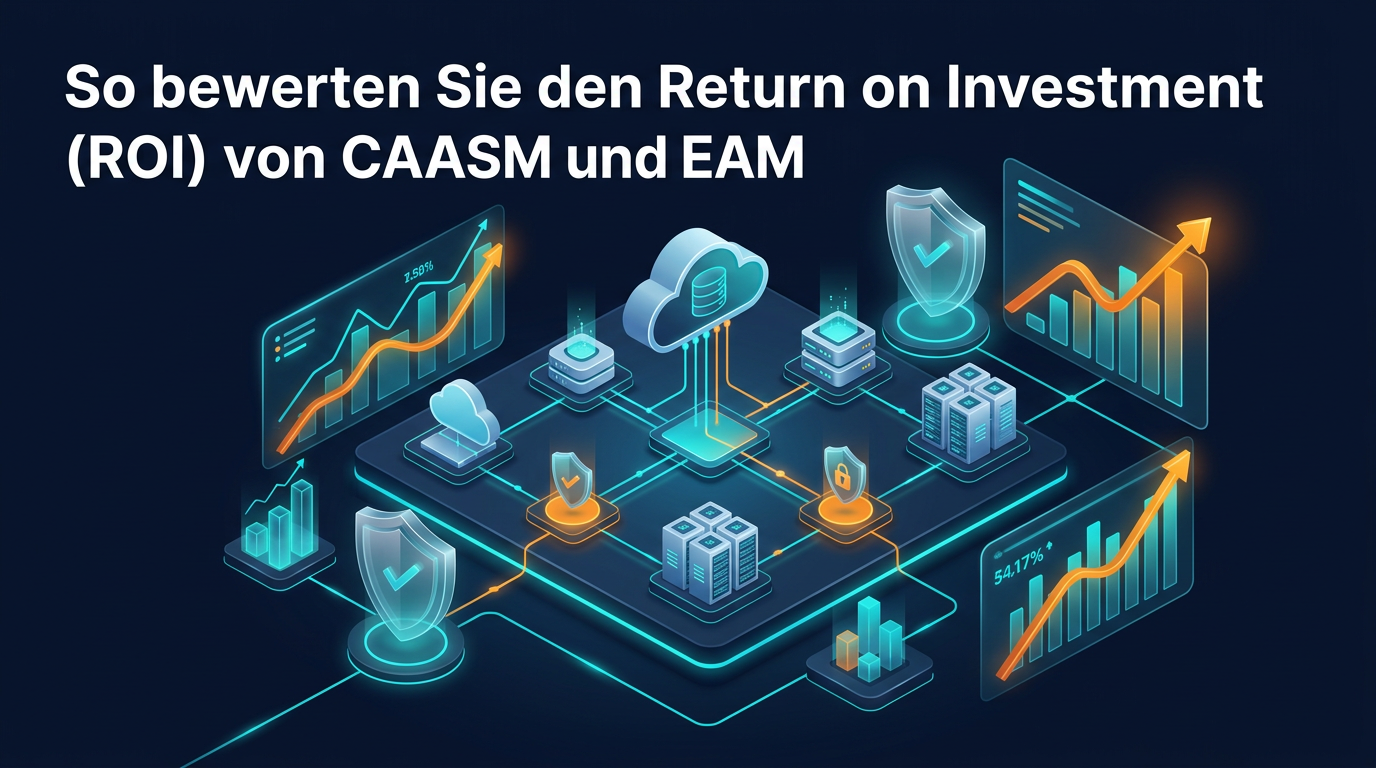
How to Evaluate the Return on Investment (ROI) of CAASM and EAM
How to Evaluate the Return on Investment (ROI) of CAASM and EAM
Budget negotiations for IT security and architecture management often follow a grueling pattern. The Chief Information Security Officer (CISO) or Enterprise Architect stands before the Chief Financial Officer (CFO) asking for budget for a new asset data platform designed to automate Cyber Asset Attack Surface Management (CAASM) and Enterprise Architecture Management (EAM).
The CFO looks at the numbers and asks: "We invested millions in new firewalls and cloud licenses last year. Why do we now need another tool that seemingly 'only' collects and aggregates data from these existing systems? Where is the concrete, financial Return on Investment (ROI)?"
It is a valid question. While a firewall represents a measurable blockade against attacks, a data platform (the "Single Source of Truth") appears abstract at first glance. In this post, we provide IT decision-makers with the hard, monetary arguments to make the business case for CAASM and a historicized CMDB bulletproof for management. The ROI lies not in the aggregation of data itself, but in the massive inefficiencies and risks that this data eliminates.
ROI Factor 1: The Eradication of Cloud Costs (FinOps)
The strongest and fastest argument for the CFO is the direct saving of hard costs. The cloud bill in most large companies is a black hole.
As we have covered in previous posts (keyword: Orphaned Assets), orphaned virtual machines, unused storage volumes, and oversized instances in AWS or Azure produce enormous, senseless costs. Departments provision resources and forget about them.
A CAASM/CMDB platform like Qbilon identifies these cost drivers fully automatically through API correlation. When the system shows that 15 percent of monthly cloud spending flows into systems that haven't recorded CPU utilization or traffic for weeks, this amount can be saved directly. Business Case: In medium-sized companies, the investment in the asset platform often pays for itself through these FinOps savings alone in the first quarter (Immediate Added Value).
ROI Factor 2: The End of Audit Time Waste
The second hard cost block is the inefficient use of personnel (FTEs). Preparing for compliance audits (NIS-2, ISO 27001, BSI Grundschutz) is a resource eater of gigantic proportions.
When highly paid cloud engineers, security analysts, and compliance managers sit in a "war room" for weeks to export log files, reconcile Excel lists, and generate evidence for auditors, the company is burning massive amounts of money. These experts should actually be working on innovations or real security issues.
Through historicization ("Time Machine") and the possibility of "Push-Button Evidence" (generating evidence at the touch of a button), a modern asset platform reduces this manual effort by up to 80 percent. Business Case: Calculate the saved working hours (FTE) of the entire IT team for audit preparation and monthly compliance reporting against the cost of the platform. The ROI is striking.
ROI Factor 3: Radical Reduction of Downtime (MTTR)
Time is money, especially when business-critical systems fail (downtime). When the ERP system strikes or the logistics software freezes, the clock is ticking.
Without data-driven Enterprise Architecture (EAM) and an up-to-date CMDB, administrators spend hours in root cause analysis trying to find out which firewall rule or which patch caused the failure. Systems are too complex for manual debugging. With a historicized "Single Source of Truth," the ITOM team compares the current state with yesterday's state (diff analysis) and sees the faulty change in a fraction of a second.
Business Case: The Mean Time to Resolution (MTTR) drops drastically. Every outage costs the company tens of thousands of dollars (production downtime, lost sales). If the platform shortens just two major IT outages per year by one hour each, it has more than paid for itself.
ROI Factor 4: The Invisible Risk Avoidance (Security)
The final factor is the most difficult, but simultaneously the most important: the avoidance of catastrophes. How much is a non-existent hacker attack worth?
CAASM minimizes the attack surface. It uncovers shadow IT and shows the security team where the EDR agent is missing on business-critical servers (coverage gaps). It prioritizes vulnerabilities based on business context. If a ransomware attack is successful through an unpatched test server (which would have remained invisible without CAASM), the costs for business interruption, forensics, reputational damage, and potential NIS-2 fines are in the millions.
Business Case: CAASM is the best insurance policy against "Log4j trauma" and the consequences of shadow IT. It makes the massive investment in already existing security tools (like EDR and scanners) effective in the first place by closing their blind spots.
Conclusion: Transparency is a Hard Business Case
Buying an asset data platform is not an academic IT exercise. It is a strategic business decision.
When arguing before the CFO, do not speak about API interfaces and normalization algorithms. Speak about eliminating dead cloud costs, freeing expensive IT specialists from audit hell, drastically reducing downtime, and protecting against ruinous cyberattacks through attack surface reduction. The ROI of CAASM and automated asset management is not abstract – it is the most measurable and quickly realizable return in modern IT strategy.