CAASM vs. CMDB: What are the Differences and Why Do You Need Both?
CAASM vs. CMDB: What are the Differences and Why Do You Need Both?
Whenever a new technology category conquers the IT market, a certain degree of confusion regarding the distinction from existing systems naturally arises in the first few months. The rapid rise of Cyber Asset Attack Surface Management (CAASM) is no exception.
In IT departments and at strategy meetings, one question is currently being discussed very frequently and very heatedly: "We only just implemented an expensive CMDB (Configuration Management Database) two years ago to manage our assets. Why do we need CAASM now? Isn't it exactly the same thing?"
The short answer is: No, it is absolutely not the same thing. Anyone trying to solve CAASM problems with a classic CMDB will fail just as much as someone trying to handle IT Service Management with a pure CAASM tool. In this post, we draw a clear line between the two concepts, highlight their respective strengths, and explain why they are not competitors but symbiotic partners in a modern IT strategy.
The CMDB: The Backbone of IT Operations
The Configuration Management Database (CMDB) is the heart of IT Service Management (ITSM). Its focus is heavily on IT Operations, business management control, and compliance.
The core question of the CMDB is: "What do we own, what do we use it for, and who is responsible?"
Its primary use cases are:
- Incident & Problem Management: When a service fails, the administrator looks into the CMDB to see which servers and databases (Configuration Items) are attached to that service and how they are connected (Dependency Mapping).
- FinOps & License Management: The CMDB helps answer whether the company has purchased enough software licenses or if unused cloud servers (Orphaned Assets) are causing unnecessary costs.
- Compliance & Audits: For NIS-2 or ISO 27001, the CMDB provides "push-button evidence" (historicized records) that processes such as patch management were followed.
The CMDB is extremely strong at mapping the business context of an asset. It knows that Server X is responsible for payroll. However, it usually has a blind spot when it comes to highly dynamic security metrics.
CAASM: Viewing Through the Lens of the Attacker
CAASM, on the other hand, was born from a pure cybersecurity perspective. It cares less about depreciation, license costs, or ITIL processes. Its focus is 100% on identifying and reducing security risks.
The core question of CAASM is: "Where are we currently vulnerable and how can an attacker exploit that?"
Its primary use cases are:
- Finding Security Coverage Gaps: Discovering systems where mandatory security software (such as EDR agents) is missing or misconfigured.
- Detecting Shadow IT: Finding unauthorized cloud instances and SaaS applications by correlating network, identity, and cloud data.
- Risk Prioritization: Aggregating vulnerabilities (CVEs) from various scanners and evaluating them.
CAASM is extremely strong at assessing the security posture of an asset in real-time. However, as an isolated tool, CAASM often lacks deep knowledge of how important a system is to the economic success of the company.
Convergence: Why You Need Both
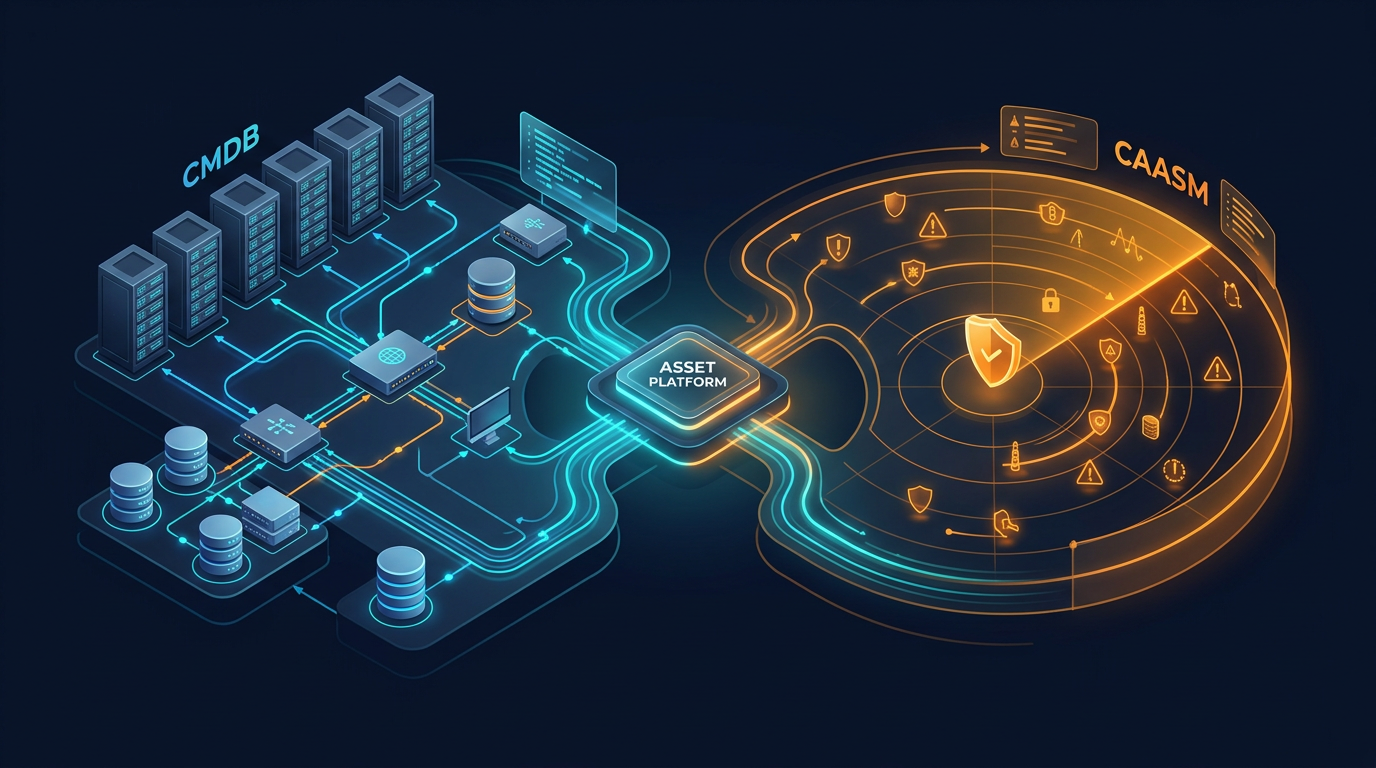
When you look at the strengths and weaknesses of both systems, the solution becomes obvious: the systems complement each other perfectly. They are two halves of the same brain.
Scenario without integration: An isolated CAASM tool reports: "Warning, we have found a critical vulnerability on IP address 10.0.5.55!" The security team now knows about the risk but doesn't know who is allowed to shut down the server or whether customer data is stored on it. A game of "ticket ping-pong" with the IT Operations department ensues.
Scenario with integration (The Symbiosis): CAASM identifies the vulnerability on IP 10.0.5.55 and queries the CMDB for context in milliseconds. The combined platform now reports: "Warning! Critical vulnerability on the central ERP database server. Business owner is Ms. Miller from accounting. If this server is patched, three logistics processes will fail."
The security team now has not only the alert but also the entire operational and business context to make a risk-based decision and immediately involve the right people in the remediation process.
Qbilon: Merging the Worlds
In practice, using two completely separate systems (an expensive CMDB for operations and a separate, expensive CAASM tool for security) often leads to massive friction, data inconsistencies, and exploding costs.
This is precisely where the strategic strength of a modern, API-driven Unified Asset Data Platform like Qbilon lies. Qbilon unites the disciplines. Through seamless inventory, dependency mapping, and historization, it delivers the perfect CMDB functionality for ITOM, FinOps, and NIS-2 compliance.
At the same time, Qbilon consistently refines this data treasure: By correlating it with security data from EDR systems and vulnerability scanners, it provides exactly the attack surface analysis, coverage gaps, and shadow IT detection that make up a full-fledged CAASM.
The result is a single, powerful "Single Source of Truth" that empowers both the CIO (costs and operations) and the CISO (security and risk minimization). You don't have to choose between CMDB and CAASM – you need a foundation that can do both.