Resource-efficient IT Monitoring: Monitoring without Performance Degradation
Putting an End to Agent Sprawl: Why Agentless IT Asset Management is the Superior Architecture
In the effort to establish full transparency and security in IT networks, companies have often resorted to a nearby but ultimately extremely painful method in recent years: the mass rollout of software agents.
For almost every conceivable purpose, a small program (an agent) was installed on servers and employees' end devices. There is an agent for virus protection (EDR), an agent for software inventory (ITAM), one for network performance (APM), one for patch management, and sometimes even a special agent that monitors whether the other agents are still running.
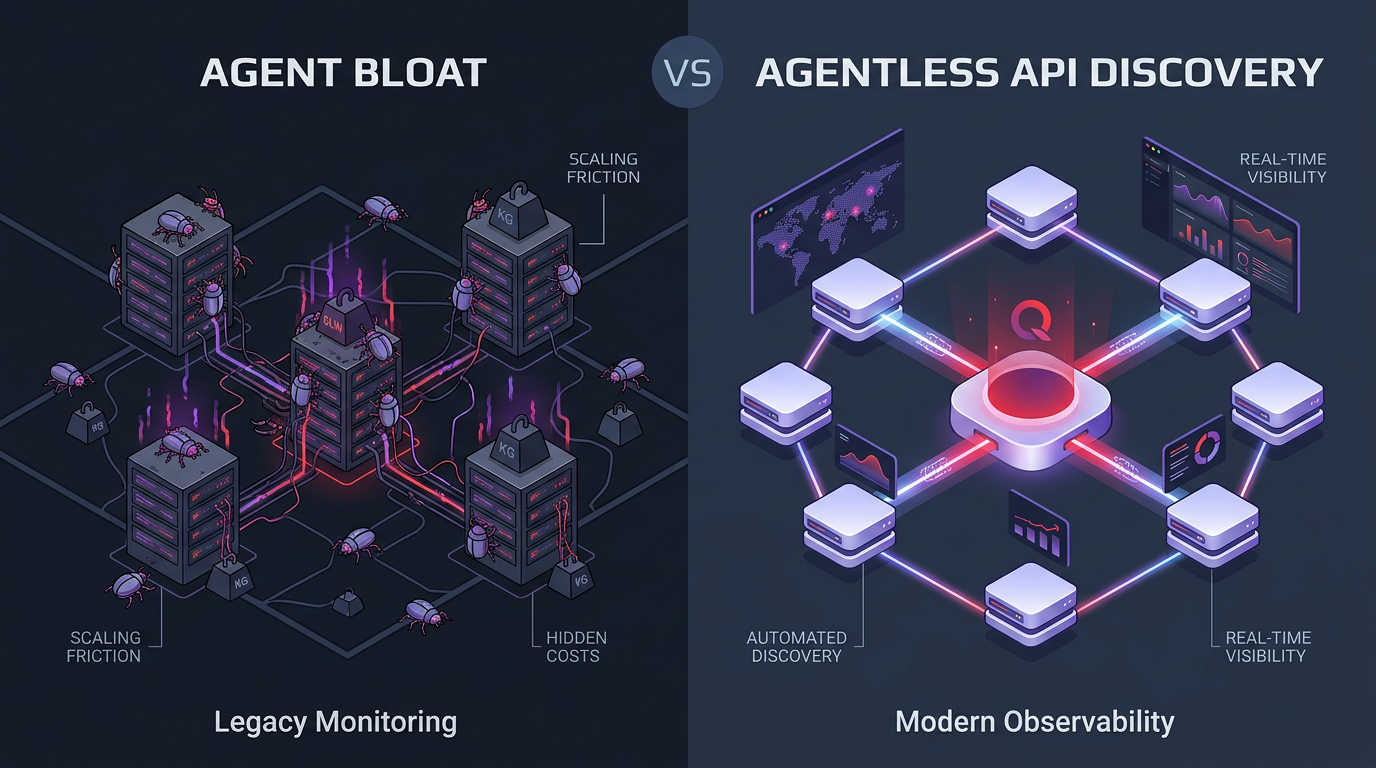
In IT operations practice, this approach has led to a phenomenon that administrators refer to as "Agent Fatigue" and "Agent Bloat." In this post, we discuss why this approach no longer scales today, how it endangers the performance of business-critical systems, and why API-based, agentless monitoring is the elegant, resource-efficient solution of the future.
The Suffering of "Agent Bloat"
At first glance, an agent seems like a logical solution: it sits directly on the operating system and dutifully reports data back to the central management server. However, in a typical enterprise environment, this principle multiplies into a massive problem:
- The Performance Parasite (Resource Consumption): Every agent consumes CPU cycles, RAM, and network bandwidth. If five different security and management agents on a business-critical database server try to scan the hard drive or parse log files simultaneously, the performance of the actual database drops noticeably. In the worst case (as seen in the notorious CrowdStrike incident in July 2024), a faulty configuration update can force millions of systems worldwide into a "Blue Screen of Death" (BSOD).
- The Administrative Nightmare: Agents must be installed, configured, and (this is the critical point) regularly updated. If a company operates 5,000 servers and 10,000 employee laptops, managing five different agent suites is a full-time job for an entire IT team.
- The Blind Spot of the Cloud (Ephemeral IT): As we know, many assets in modern cloud environments (such as AWS or Kubernetes) often exist for only minutes. Installing a heavy ITAM agent during this short lifespan, which then reports data back, is technically nonsensical and often impossible. Furthermore, manufacturers of specialized OT systems (industrial controls) often vehemently (and rightly) refuse to allow foreign software agents on their fragile systems.
The Way Out: Agentless API Discovery
To solve these problems, a technological paradigm shift is taking place in modern IT Asset Management. The motto is: "Use the data that is already there."
Modern asset data platforms like Qbilon do not require their own agent that intervenes deeply in the server's operating system. They work agentlessly (Agentless Discovery). Instead, the platform uses interfaces (APIs) to talk to the central systems that already manage the infrastructure.
- In the Cloud: Instead of installing agents on 500 AWS instances, Qbilon speaks directly to the central AWS API. The cloud already knows best which instances are running, which IP addresses are assigned, and which storage volumes are attached.
- In the Data Center: The platform queries the VMware vCenter server instead of burdening every single virtual machine.
- In Network and Security: Data from Active Directory, the existing vulnerability scanner, and the firewall are centrally aggregated and correlated in Qbilon.
The Advantages of Resource-Friendly Monitoring
This API-driven approach provides companies with three massive advantages at once:
- Zero Impact on Business Systems: Since no software is installed on the actual servers or end devices, there is no performance degradation (Zero Performance Impact). Databases and applications run smoothly while asset management silently collects metadata via central APIs in the background.
- Lightning-Fast Deployment (Time to Value): Rolling out agents across thousands of servers takes weeks, often months (due to change management processes). Connecting a cloud environment via API (as with Qbilon) often takes only a few minutes (setting up a read-only service account). The first asset data flows onto the dashboard immediately (Immediate Added Value).
- 100% Coverage (No System Can Hide): An agent can only report what it knows. If a developer sets up a server and "forgets" to install the agent, the server is invisible. An API that looks directly at the hypervisor or the cloud control plane sees everything that is booted up.
Conclusion: Intelligent Aggregation instead of Blind Installation
Transparency and security do not have to be bought at the expense of system stability and IT resources. The mass rollout of management agents is a strategy of yesterday that is doomed to fail in agile cloud environments and sensitive OT networks.
The key to a resource-efficient, all-encompassing asset inventory lies in the intelligent aggregation and correlation of existing data. With an API-based, agentless approach like that of Qbilon, you relieve your servers, free your administrators from update stress, and still obtain the 100% historized real-time overview that you urgently need for audits and security.