
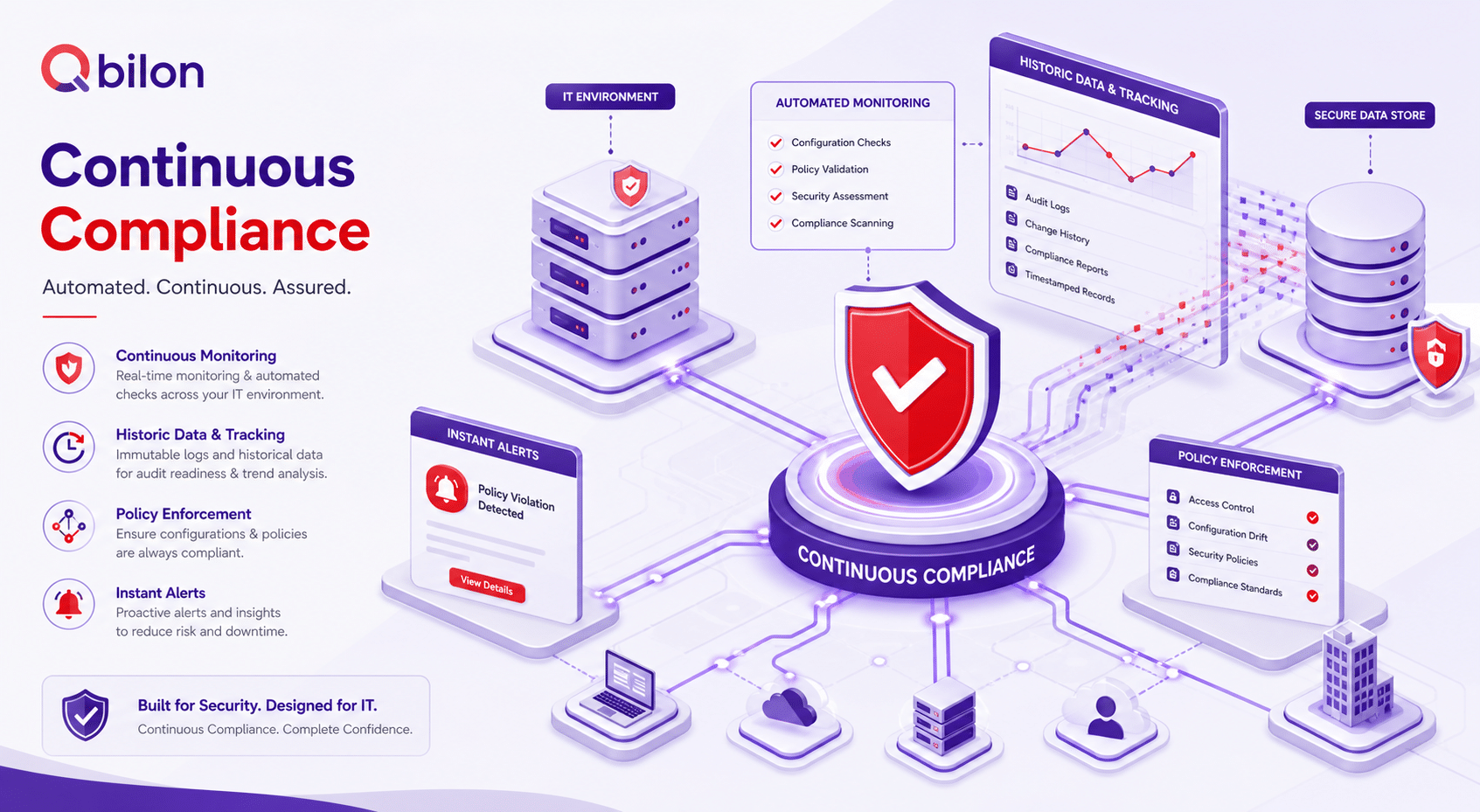
Historical Data as the Key to Continuous Compliance
If you throw the word "Compliance" into an open-plan office full of IT experts, you usually get rolling eyes, deep sighs, and a sudden craving for a strong coffee. Compliance – adhering to legal and normative requirements such as NIS-2, GDPR, or internal security policies – is inextricably linked in the minds of many IT teams with the dreaded "Audit mode".
This "Audit mode" resembles a fire-brigade-style special operation: once a year, just before the auditors arrive, everyone drops their pens. Servers are hastily patched, log files archived, firewall rules cleaned up, and pages of documentation written to give the organization a temporary veneer of regulatory conformity. As soon as the auditors are gone, the organization relapses into old, less disciplined patterns.
The "stop-and-go principle" is not only inefficient and stressful, it is also simply dangerous these days. The NIS-2 implementation law, which has been in force in Germany since December 2025, and the underlying EU directive demand seamless proof of permanent security measures – a requirement that makes Continuous Compliance a strategic imperative. In this post, we show why historical data is the only key to achieving this permanent state.
The deceptive concept of the snapshot
The problem with the reactive "fire-fighting mentality" before audits is that it only produces a snapshot. If you can prove on the day of the audit that all 500 servers in your company are equipped with the latest anti-virus software, you prove exactly one thing: that they are equipped today.
Modern frameworks like NIS-2 are no longer satisfied with this. Cyber threats don't take a break, so the defense shouldn't take a break either. Regulators demand proof that security measures take effect permanently, seamlessly, and without interruption.
An auditor will ask: "I see that today all systems comply with the guidelines. Please prove to me that in the ten months since our last meeting, every newly provisioned cloud server was included in your monitoring system within 24 hours and that there was never a gap in your surveillance."
Anyone who can only present the daily updated report of their CMDB at this point has a massive problem. Without a look into the past, Continuous Compliance is unprovable.
Historical data: Proof of the process
The concept of Continuous Compliance implies that there is an automated process that immediately detects and remediates deviations from the target state, and that this process has functioned reliably over time.
To prove this, you need a technological infrastructure that functions as an immutable "IT memory". An automated asset platform like Qbilon is designed exactly for this purpose. Through permanent, API-driven monitoring of the entire IT landscape and the storage of all states with a timestamp (historization), it provides the crucial building blocks for Continuous Compliance:
Seamless tracking of changes (Change Management) You can prove that no firewall rule and no cloud configuration was changed without the system registering it. If a developer opens a port without authorization, this is noted in the history – including the time of remediation.
Proof of patching behavior Continuous Compliance does not mean that a vulnerability never exists in the network (that is practically impossible). It means that vulnerabilities are closed within a defined timeframe (SLA). The historical data of the asset platform proves how many days passed between the time outdated software was installed on a server and the time of the update.
Lifecycle documentation You can seamlessly prove that systems complied with internal security policies throughout, from the day they were added to the network (onboarding) to the day they were securely deleted (offboarding).
Automated controls (Policy Enforcement)
The final, magical step towards Continuous Compliance is the automation of the controls themselves. Instead of an employee checking reports monthly, the compliance team defines hard rules (policies) in the asset platform. For example: "Every asset that processes customer data must be encrypted."
The platform monitors this rule in the background against the historical and current state of the infrastructure in real-time. As soon as a server appears that violates this rule, the system immediately sounds an alarm or triggers an automated workflow for remediation. The state of rule violation is thus only of extremely short duration.
Conclusion: From a compulsory exercise to a competitive advantage
Those who establish Continuous Compliance undergo a cultural change in IT. Adhering to rules shifts from a tiresome, once-a-year compulsory exercise to an invisible process integrated into everyday life.
The "Audit mode" disappears. If an auditor shows up unannounced, it no longer creates stress. You open the dashboard of your historized asset management platform, generate a report for the period of the last twelve months, and present the watertight, data-driven proof that your company takes cybersecurity seriously every day. Historical data is not just backups of tables – it is the incorruptible witness to your operational excellence.