Audit-Readiness: What Auditors Expect from Your IT Documentation in 2026
There is hardly any email that reliably causes more unrest in IT departments than the appointment announcement of an external Audit. Whether for ISO 27001 recertification, a review according to BSI IT-Grundschutz, or – currently dominating – the evidence requirements of the NIS-2 directive: an Audit traditionally means weeks of preparation, overtime, and the frantic updating of outdated documents.
However, the Audit landscape has fundamentally changed in 2026. Auditors have drastically sharpened their way of working and their expectations of modern IT organizations. The days of so-called "tick-box Compliance," where it was sufficient to present smooth-sounding Security policies as a PDF document, are finally over.
In this post, we take a detailed look at the new reality in Audits and highlight what external auditors now strictly expect from your IT documentation and your Asset management – and how you can achieve a state of permanent "Audit-readiness."
The Evolution of the Audit: From Paper to Hard Data
In the past, Audits often resembled a theoretical interview. The auditor asked: "Do you have a process for onboarding new Servers?" The IT manager nodded, showed a process diagram from 2021, and the box (tick-box) was checked.
Today, we live in an era of hybrid Clouds, Infrastructure as Code, and massive cyber threats. Auditors know that paper is patient. They demand technical truth. If you say today that you have a process, the auditor's follow-up question is inevitably: "Prove it to me. Show me the data for all Servers provisioned in the last six months and prove that the required security agent was installed on every single one."
This demand for hard evidence is based on the experiences of recent years, where devastating cyberattacks often hit companies that were "fully compliant" on paper. The discrepancy between policy and technical reality was simply too large.
The Top 3 Expectations of Modern Auditors
When you sit across from an auditor in 2026, they will measure your IT documentation (your CMDB or your Asset inventory) by three essential criteria:
Radical Completeness (Zero Tolerance for Shadow IT) An inventory that only maps systems in the local data center but ignores the AWS environment of the development team or the SaaS applications of the marketing department is worthless. Auditors expect a "Single Source of Truth" that covers all areas: On-premise, public Cloud, private Cloud, endpoints, and increasingly, Operational Technology (OT). Anyone who shrugs their shoulders at the question of unauthorized shadow IT will receive a non-conformity. You must be able to prove how you automatically scan the network for unknown Assets.
The Historical Dimension (Continuous Compliance) As discussed in detail in previous posts, history is the new gold standard. Auditors no longer check key dates; they check periods of time. They want to see how quickly the company responded to new vulnerabilities (patch management history). They want to be able to trace who owned a compromised Server three months ago. IT documentation that simply overwrites old data states is considered insufficient today. The expectation is an "IT memory" that logs every change immutably.
Connected Context Instead of Flat Lists A Server is not an isolated object. Auditors today expect you to be able to name the criticality of an Asset immediately. If an auditor points to an IP address in your system, you must be able to answer the following questions:
- Which business process is dependent on this system?
- Is personal data (GDPR relevance) processed here?
- Which other systems are networked with this Server? Without this relationship context (Dependency Mapping), the risk of an Asset cannot be assessed.
The End of the "War Room"
The classic reaction of many companies to these high requirements is to set up a "war room" four weeks before the Audit. Highly qualified experts are pulled away from their actual tasks to sift through log files, reconcile Excel spreadsheets, and manually prepare data for the auditor.
This approach is an economic disaster and prone to error. If an auditor notices that evidence was manually "assembled" for the audit appointment, all alarm bells go off, as this indicates a lack of established processes in everyday operations.
True Audit-Readiness through Automation
The term "Audit-readiness" means that a company could be audited at any time, unannounced, without falling into a panic.
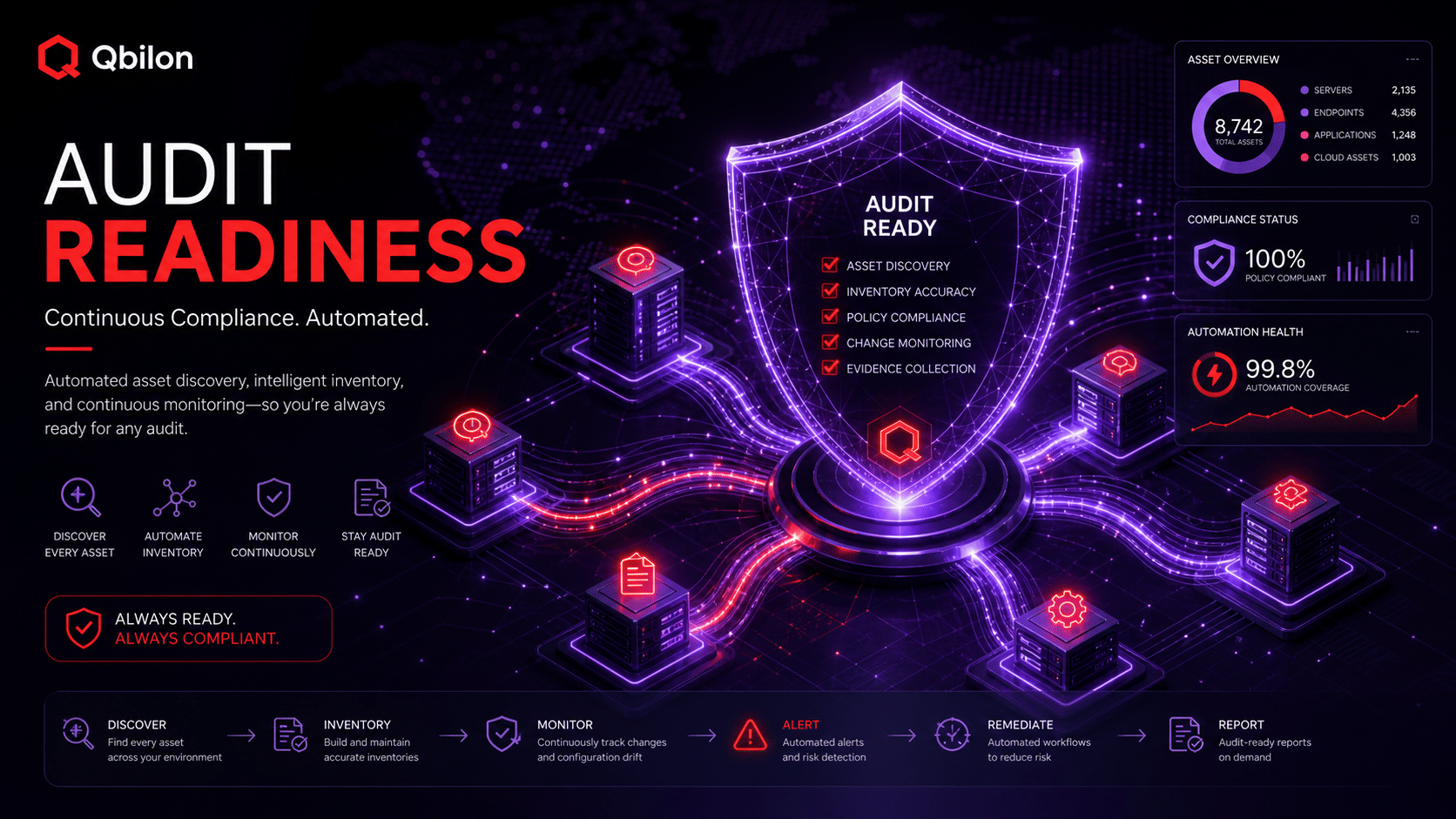
This state can only be achieved through automation. An intelligent platform like Qbilon completely takes this burden off IT teams. Through API-based connection to all relevant data sources in the company, Qbilon continuously creates a seamless, historized, and context-rich image of the IT landscape.
When the auditor requests data from the last six months, the IT manager does not export it from half a dozen different tools, but generates a verified, tamper-proof report from the central Qbilon platform – at the push of a button, in a few minutes.
Conclusion: The Audit as a Driver for Operational Excellence
Audits are exhausting, but they are not the enemy. The strict demands of NIS-2 and ISO auditors in 2026 reflect exactly what an IT organization should need anyway to manage its operations efficiently and securely.
Companies that automate their IT documentation and say goodbye to static lists do not just lose their fear of the next Audit. They gain massive transparency, reduce their downtime, and create the foundation for proactive cybersecurity. Make Audit-readiness a byproduct of your excellently organized, automated IT.