The ''Single Pane of Glass'' Promise: Reality or Marketing Myth?
The "Single Pane of Glass" Promise: Reality or Marketing Myth?
If you have attended a presentation by a software vendor in the last ten years – whether for network monitoring, Security Information and Event Management (SIEM), ITSM, or cloud management – you have almost certainly heard one specific term: the "Single Pane of Glass."
The vision sold with this term is captivatingly attractive. It goes like this: "Buy our product, and all your fragmentation problems are solved. Your CIO, your CISO, your network admins, and your cloud engineers will all look at the same, tidy screen in the future and see the entire truth of the company at a glance."
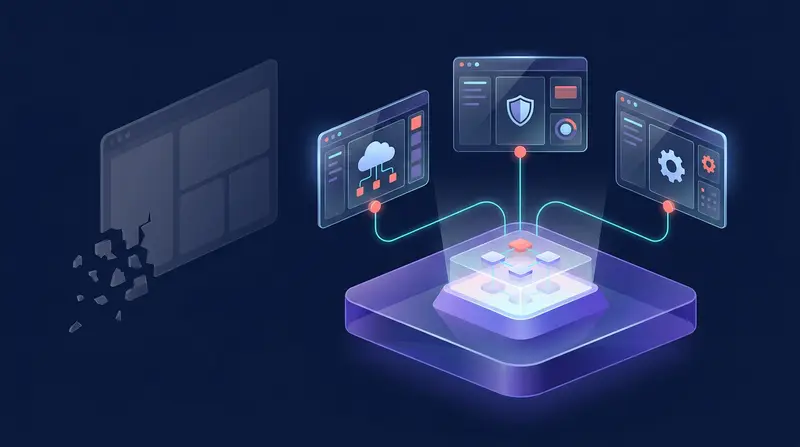
However, the reality in almost all companies looks fundamentally different. In control centers (SOC/NOC), dozens of screens still hang on the walls, where employees jump wildly back and forth between different dashboards, browser tabs, and consoles. The Single Pane of Glass has often turned out to be a gigantic marketing myth, an expensive castle in the air.
In this post, we debunk the myth of the "one super-tool" that is supposed to replace everything and show how you can turn the actual idea behind the vision – breaking down data silos – into reality through an intelligent "Unified Data Plane" (such as CAASM/CMDB).
Why the "Super-Tool" Approach Fails
The attempt to establish a single, all-encompassing tool (a monolith) in a modern enterprise environment almost always fails due to the complexity and specialization of the departments.
- The Best-of-Breed Approach Always Wins Your IT experts are highly specialized. A cloud architect needs the deep, native granularity of the AWS console to debug complex container orchestrations (Kubernetes). A security analyst needs the specialized filters and threat intelligence feeds of their EDR system (e.g., CrowdStrike) to hunt for malware signatures.
If a vendor now sells a "Single Pane of Glass" that claims to combine all these functions into a single dashboard, a compromise is inevitable. The super-tool can do a little bit of everything, but nothing correctly. It is the proverbial Swiss Army knife approach: good for emergencies, but no expert builds a house with it. Specialists refuse to use the compromised super-tool and continue to work secretly with their specialized tools.
- Vendor Lock-in If you try to manage your entire IT visibility through a single tool from a single vendor, you make yourself 100% dependent. If you change your cloud provider or your security concept in two years, the entire construct collapses.
The Reality: The "Unified Data Plane" (Single Source of Truth)
The error in reasoning lies in the user interface (the glass). The solution for fragmented IT landscapes is not that all departments must look at the same glass (dashboard). The solution is that all departments work with the same database.
This is the concept of the "Unified Data Plane" or "Single Source of Truth," as perfected by modern platforms like Qbilon.
Instead of trying to replace the AWS console or the security tool, the platform sits as an intelligent meta-layer (or asset hub) between the silos.
- Data Aggregation via API: The platform pulls the raw, highly specialized data from the best-of-breed tools of the specialist departments.
- Normalization and Correlation: It brings the data together, cleans up duplicates, and uncovers inconsistencies (e.g., the blind spot the EDR tool has in the cloud – CAASM principle).
- Democratization of Data: The cleaned, context-rich truth is now made available to all teams. The security analyst suddenly sees in their own dashboard who owns the infected server (business context from the ITSM). The ITSM admin sees in their ticket system that the server has a critical vulnerability.
Conclusion: Connect Data, Not Dashboards
The promise that a single software product will make all other dashboards in your company redundant is an illusion. Accept that modern IT is complex and specialists need specialized tools.
The true goal you must pursue is not the "Single Pane of Glass," but the "Single Source of Truth." By establishing an automated, historicized, and API-driven asset database as a central hub, you let your experts work in their familiar environments – but provide them all with the same, incorruptible, context-rich, and complete data material. This is not marketing fiction; this is applied operational excellence.