ITOM Optimization – How Reliable Historical Data Helps in Root Cause Analysis
Friday afternoon, 2:30 PM. In the IT control center, dashboards suddenly flash red. The central ERP system, the backbone of the entire company, is no longer responding. Users from logistics are calling the helpdesk every second because delivery notes can no longer be printed. Production is at risk of coming to a standstill. At this moment, the race against time begins for IT Operations Management (ITOM). Every minute of downtime costs the company thousands of euros – and severely damages the reputation of the IT department.
In 80 percent of cases, the first and most important question asked in hastily convened crisis meetings is: "What has changed?"
Systems rarely fail "just like that." Usually, there is a trigger: a nightly firewall update, a disk that went full unnoticed on a dependent database server, a changed routing table, or a faulty patch. The art of troubleshooting lies in so-called Root Cause Analysis (RCA) – the search for the true cause of the problem. And this is exactly where many IT departments fail miserably because they lack a crucial tool: historical Asset data.
The Problem of the Pure "Current State" View
When the IT team tries to analyze the failure of the ERP system, they intuitively turn to the Configuration Management Database (CMDB) or network monitoring. The problem with traditional, manually maintained, or purely real-time status-focused CMDBs is that they – as the name suggests – only show the current state.
The administrators see in the database:
The ERP Server is running
CPU utilization is at 100%
The connection to the database server is interrupted
This is the description of the symptom. However, it provides no clues as to the cause. To find out why the connection is interrupted, the actual "heavy lifting" begins. Network specialists scour switch logs, database admins dig through page-long error files, and Cloud engineers check security groups in AWS. Phone calls are made frantically: "Did anyone tweak the firewall last night?"
This process is highly inefficient, extremely stressful, and dramatically increases the Mean Time to Resolution (MTTR) – the average time it takes to fix the outage.
The "Time Machine" as a Gamechanger in ITOM
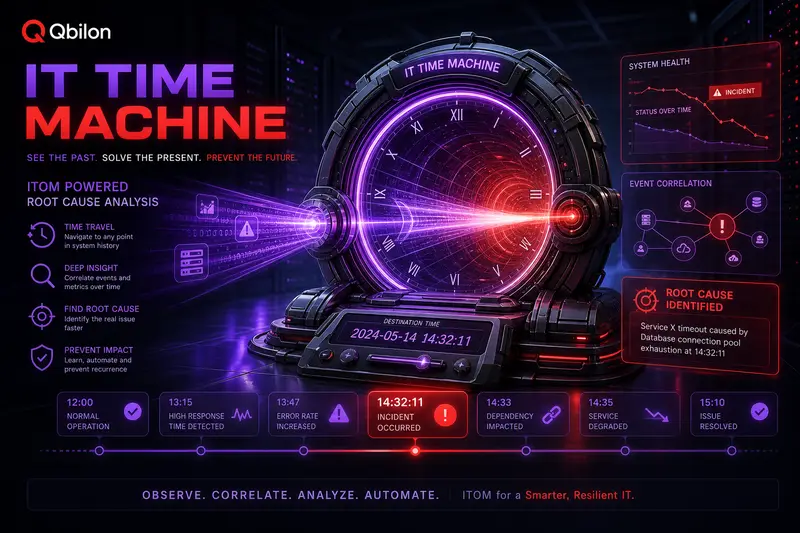
What does Root Cause Analysis look like in a modern, data-driven IT organization? The fundamental difference is the existence of automated historization, often affectionately referred to as the "IT Time Machine."
Platforms like Qbilon do not just store what the IT landscape looks like today but record every past state seamlessly and automatically. If the ERP system fails at 2:30 PM, the ITOM team can perform the following steps in seconds:
Compare the timeline (Diff analysis): The team selects two points in time in the platform: Today, 2:30 PM (the faulty state) and Yesterday, 2:30 PM (the working state). The system compares all metadata, configurations, and dependencies of the Infrastruktur and generates a so-called "delta" (a diff).
Isolate the trigger: The system immediately shows: Attention, between yesterday and today there were exactly three changes in the environment of the ERP system.
Change 1: A Windows patch was installed on the web server. Change 2: A new storage block was assigned to the database. Change 3: A colleague from the network team adjusted a firewall rule between the application server and the database server this morning at 9:15 AM.
Targeted remediation instead of guesswork: The cause is almost always isolated immediately. Instead of parsing logs for hours, the network team can specifically roll back the faulty firewall rule (Change 3). The system is running again, production continues. The MTTR drops from several hours to a few minutes.
Synergies between ITOM and Compliance
Interestingly, the circle closes here with the regulatory requirements we discussed in previous posts. The technological foundation you need to use historical data for fast error analysis (ITOM) is exactly the same foundation you need to generate rock-solid evidence for a NIS-2 Audit.
When you implement an automated Asset platform like Qbilon, you literally kill two birds with one stone. You don't just satisfy the CISO and external Auditors with seamless Compliance proof. You also provide the CIO and IT operations with a powerful tool to drastically increase system availability and minimize downtime.
Conclusion: Data Instead of Gut Feeling
The times when IT problems were solved by "gut feeling," asking around in open-plan offices, or digging through log files for hours must finally belong to the past. Modern, hybrid Infrastrukturs are too complex for manual error analysis.
Anyone who seriously wants to increase the efficiency of their IT Operations Management and minimize the downtime of business-critical systems needs historical transparency. An automated, historized Asset inventory is the most reliable colleague an IT administrator can have in a crisis: one who remembers every change, never forgets, and delivers the decisive answer to the question "What has changed?" in a fraction of a second.